Welcome back, everyone. Take your seats.
In our previous lectures, we mastered reverse proxies and load balancers. Today, we step into the world of Microservices and Distributed Architecture to examine a crucial component: The API Gateway.
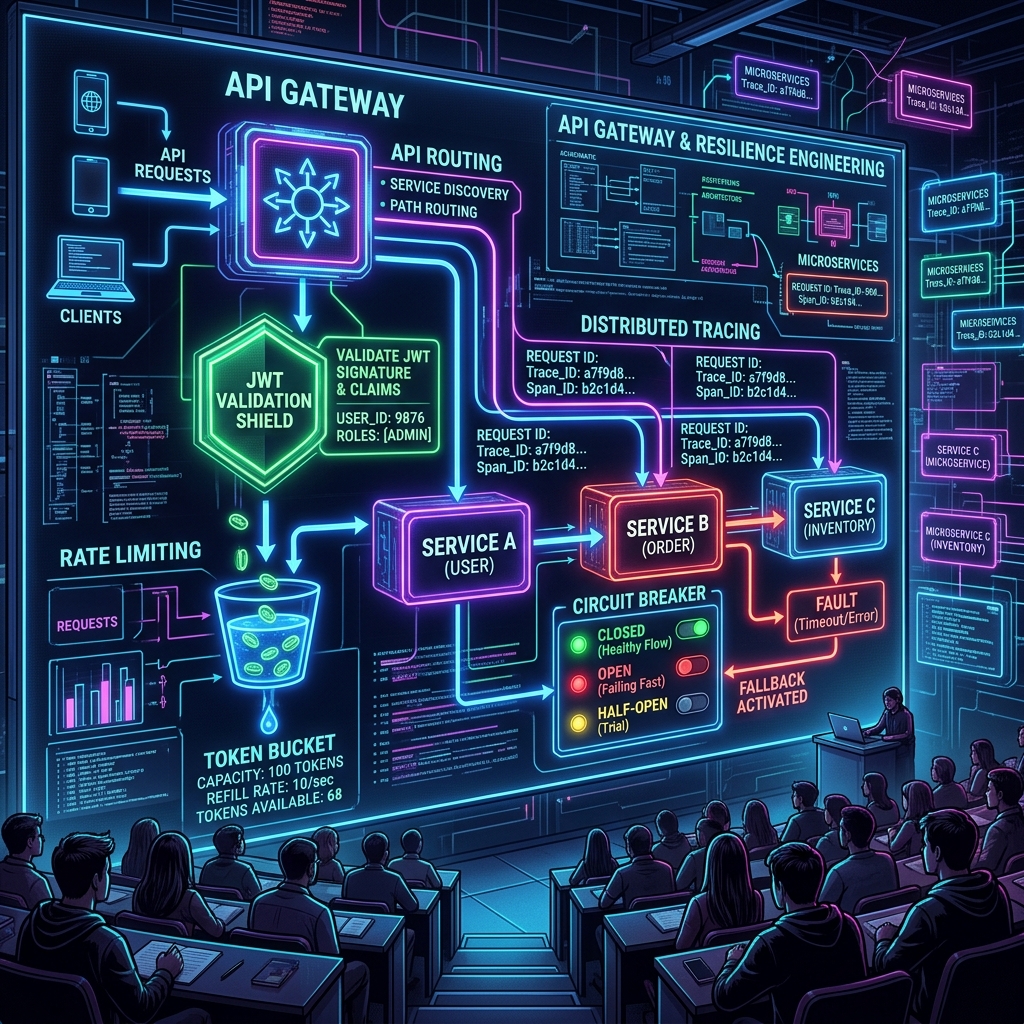
As companies split monolithic applications into dozens or hundreds of independent microservices, managing security, routing, traffic control, and failure modes across all those services becomes a nightmare. Today, we will explore how an API Gateway solves these problems and how resilience patterns keep microservices online when downstream dependencies fail.
1. Demystifying the API Gateway: How Does it Differ?
Students often ask: “Professor, isn’t an API Gateway just Nginx with a fancy name?”
While an API Gateway can be built on top of Nginx (like Kong or APISix), its architectural role extends far beyond standard reverse proxying or load balancing.
| |
Direct Microservice Exposure vs. API Gateway Entry Point
| |
When is an API Gateway Unnecessary Complexity?
If you are building a single monolithic backend on a single VPS, you do NOT need an API Gateway. Standard Nginx as a reverse proxy is more than enough. Introducing an API gateway to a simple monolith adds unnecessary network latency hops and operational maintenance.
An API Gateway becomes valuable when you have multiple microservices, distinct client types (Mobile vs Web vs Third-Party APIs), or complex cross-cutting compliance requirements.
2. Backend-for-Frontend (BFF) Pattern
Different client devices have different bandwidth, screen sizes, and data requirements:
- Mobile Client: Limited bandwidth, small screen. Wants 1 aggregated API payload with minimal fields.
- Web App: High bandwidth, desktop display. Wants rich, detailed data payloads.
- IoT Device: Ultra-low bandwidth. Needs binary/lightweight JSON payloads.
| |
Instead of forcing a single bloated API Gateway to cater to every device, the Backend-for-Frontend (BFF) pattern deploys dedicated lightweight gateways per client type.
3. Edge Authentication & Authorization
One of the greatest benefits of an API Gateway is offloading security from individual microservices.
| |
- Authentication (AuthN): The Gateway validates the incoming JWT, OAuth2 token, or API Key signature. If invalid or expired, the request is immediately rejected at the gateway edge with an
HTTP 401 Unauthorized. - Context Propagation: The Gateway decodes the JWT claims (e.g.,
user_id: 9876,role: admin) and injects them into downstream HTTP headers (X-User-ID: 9876,X-User-Roles: admin). - Downstream Simplicity: Internal microservices inside the private network don’t need to re-verify cryptographic signatures or touch session databases. They simply read
X-User-ID.
4. Traffic Control: Rate Limiting & Throttling
To protect backend services from denial-of-service (DoS) attacks or greedy clients, the gateway enforces Rate Limiting.
| |
Popular Rate Limiting Algorithms
- Token Bucket: A bucket holds up to $C$ tokens. Tokens are refilled at a constant rate $R$ per second. Each request consumes 1 token. Allows bursty traffic up to bucket capacity.
- Leaky Bucket: Requests enter a queue (bucket) and leak out at a constant, smooth rate. Smooths out traffic spikes.
- Sliding Window Log: Tracks timestamps of requests in Redis to enforce exact limits over rolling time windows (e.g., max 100 requests per 60 seconds).
5. Resilience Engineering: Circuit Breakers & Retries
In a microservices architecture, downstream failures are inevitable. If Service C slows down, Service B’s thread pool exhausts waiting for C, causing Service B to fail, which takes down Service A. This is a Cascading Failure.
To stop cascading failures, we use Circuit Breakers.
| |
Circuit Breaker States
- Closed: Normal state. All requests pass through to the downstream microservice. The gateway monitors failure rates.
- Open: The failure threshold (e.g., 50% error rate over 10s) was breached. The circuit breaker trips. All subsequent requests fail immediately at the gateway with an HTTP 503 or return a cached fallback response without touching the broken service!
- Half-Open: After a sleep timeout (e.g., 30s), the gateway allows a few probe requests to check if the downstream service has recovered. If probes succeed, the circuit resets to Closed. If probes fail, it returns to Open.
The Danger of Naive Retries: Retry Storms
If a downstream database is struggling under heavy load, and 1,000 clients automatically retry failed requests every 1 second, the retry volume doubles the load on the dying database, ensuring it never recovers. This is a Retry Storm.
Mitigation: Always implement Exponential Backoff with Jitter:
$$\text{Wait Time} = \min(\text{MaxWait}, \text{Base} \times 2^{\text{attempt}}) + \text{RandomJitter}$$6. Observability: Distributed Tracing & Correlation IDs
When a single user click triggers a call chain across 5 microservices, how do you debug a slow request?
| |
- Request/Correlation ID: The API Gateway generates a unique UUID (
X-Request-ID: e4a7b-891...) for every incoming edge request. - Header Propagation: Every microservice MUST inspect incoming HTTP headers and pass
X-Request-IDalong when making downstream internal HTTP or gRPC calls. - Centralized Log Aggregation: All logs pushed to Elasticsearch/Loki include
trace_id. Engineers can querytrace_id == "abc-123"and view the complete end-to-end execution timeline across all services!
Classroom Summary & Takeaways
Today we covered:
- API Gateway vs Reverse Proxy: Gateways bring application-level intelligence (Auth, Rate limiting, Transformation, BFF).
- Edge Security: Validate JWTs at the gateway edge to keep internal microservices clean.
- Traffic Shaping: Token Bucket algorithms absorb bursts while enforcing tenant quotas.
- Circuit Breakers: Prevent cascading microservice failures by failing fast during downstream outages.
- Retry Storms: Use Exponential Backoff + Jitter to prevent destroying recovering services.
- Correlation IDs: Always generate and propagate
X-Request-IDfor distributed tracing.
Next class: Putting It All Together — Production Architecture Blueprints & System Design Interview Scenarios. Class dismissed!